

What most leaders don’t tell you? Problems don’t exist in isolation. They’re products of complex systems interacting over time, especially in fast‑moving environments like Africa’s startup ecosystem. Without systemic thinking, confusion is inevitable.
Introduction: Where Confusion Really Comes From
At the heart of most startup struggles lies something subtle yet pervasive: fragmented thinking, the habit of addressing isolated problems without seeing the whole. This siloed mindset breeds confusion, creates recurring issues, and leaves founders reacting rather than strategizing.
Systemic thinking, a holistic approach to understanding how elements, relationships, and behaviors interact within a larger whole, is what turns chaos into clarity. By contrast, ignoring system dynamics traps founders in loops of firefighting that rarely get to the root causes of challenges.
In today’s quickly evolving African market with its diverse cultures, fragmented regulations, and resource constraints, the absence of systemic thinking can be especially costly. Whether it’s product‑market fit ambiguity, scaling woes, or inconsistent funding flows, many of these problems are systemic in nature, not isolated glitches.
Let’s unpack why this is such a blind spot and how founders can embrace systemic thinking to navigate complexity with confidence.
What Is Systemic Thinking? (And Why It Matters More Than Ever)
Systemic thinking isn’t just a buzzword; it’s a framework for understanding complexity. In contrast to linear, surface-level problem solving, it:
- Recognizes interconnections between all parts of a system
- Promotes contextual awareness of how behaviors shape patterns
- Focuses on relationships, not just components
- Aims to identify root causes, not superficial symptoms
In essence, systemic thinking zooms out to see the whole picture rather than isolating individual parts.
Example: A Simple Systemic Insight
Say you’re struggling with customer churn. A linear approach might look only at product features. But systemic thinking asks:
- How does onboarding influence long‑term retention?
- What feedback loops exist between customer support and product updates?
- Does marketing overpromise in ways operations can’t deliver?
This mindset uncovers connections that would otherwise go unnoticed because symptoms (like churn) often emerge from deeper systemic structures.
Chart: Traditional vs. Systemic Thinking Comparison
| Feature | Traditional Thinking | Systemic Thinking |
| Focus | Parts of the system | Whole system |
| Approach | Linear cause‑effect | Patterns, relationships, feedback loops |
| Outcome | Short‑term fixes | Long‑term solutions |
| Risk | Unintended consequences | Anticipation of effects |
| Ideal For | Simple problems | Complex systems |
Why African Startup Founder Struggles Are Often Systemic
The African startup ecosystem is vibrant but complex. On the surface, metrics like funding rounds, product launches, and user adoption define success. But dig deeper, and you’ll find issues rooted in interdependent systems, not isolated glitches.
1. Fragmented Markets
Africa is not a monolith; it comprises 54+ countries with diverse languages, policies, currencies, and cultures. What works in Lagos might not fly in Kigali. These cross-border differences are systemic, not random.
2. Infrastructure Dependencies
Reliable power, internet connectivity, logistics, and payment gateways are foundational to many startups. Weak infrastructure isn’t an isolated problem; it influences everything from product usage to customer retention and costs.
3. Capital Flow Complexity
Funding in African ecosystems operates in waves: foreign VC concentration, sector preferences (like fintech), and regional imbalances. These patterns influence startup survival rates across the continent.
According to recent reports, African startups collectively raised about $2.2 billion in 2024, and while this shows growth, it also points to funding volatility and structural gaps in investor ecosystems.
The African Startup System Map
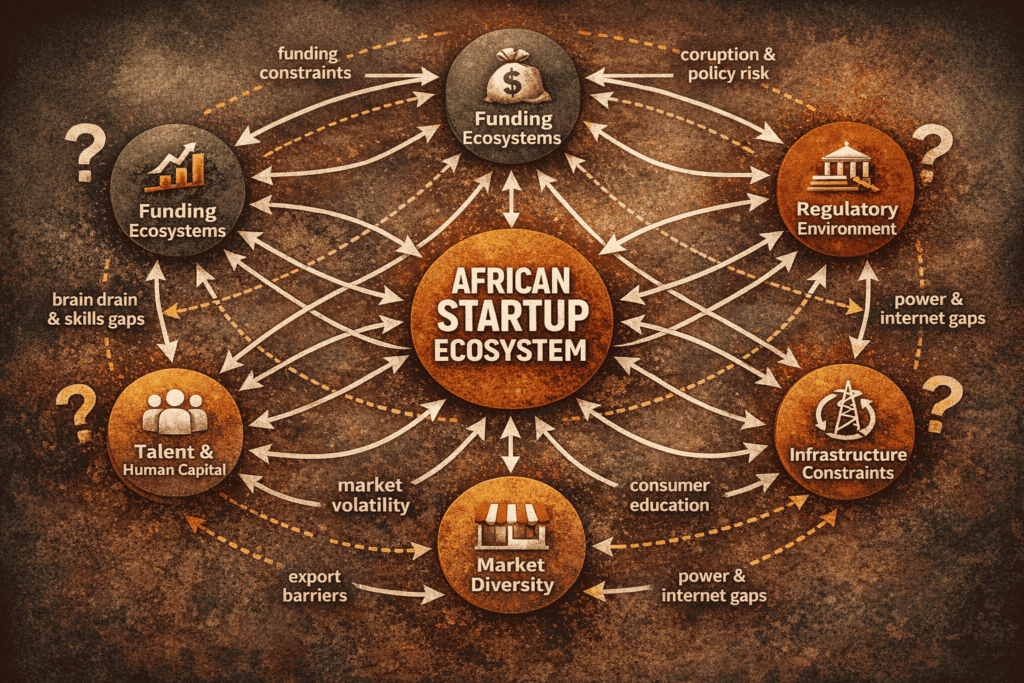
The Root of Founder Confusion: Surface Fixes in a Complex System
Founders often react to symptoms:
- “Growth is slow; let’s spend more on ads.”
- “Users aren’t sticking; let’s rework the UI.”
- “Cash is tight; let’s cut salaries.”
But without systemic thinking, these fixes often fail to address why the issue exists. You might improve a metric temporarily, but the underlying system, with its feedback loops and dependencies, continues to push problems back to the surface.
For example:
Driving more traffic (advertising) may improve acquisition, but if infrastructure issues cause downtime, retention still fails. That’s a systemic conflict between supply capacity and demand generation.
Systemic Thinking Benefits: From Chaos to Clarity
Systemic thinking gives leaders tools to:
- Identify root causes rather than symptoms
- Predict unintended consequences before deploying solutions
- Map feedback loops and leverage points
- Improve collaboration across teams and stakeholders
- Build long‑term resilience into strategies
According to thought leaders, systems thinking promotes a holistic understanding of problems, reducing unintended outcomes and enhancing long‑term decision-making. (JWU Online)
Real-World Startup Challenges That Demand Systemic Insight
Let’s ground this in real founder contexts.
Scaling Without Structural Readiness
Many African startups experience early traction but falter when scaling, not because of a lack of product merit but due to underlying structural misalignments (operations, HR, governance). These are system failures, not product issues.
Funding Failures
Even viable startups can struggle to secure follow‑on funding because investors perceive systemic risks, fragmented markets, regulatory uncertainty, and a lack of exit infrastructure, which are not addressed by short‑term performance improvements alone.
Talent Fragmentation
Talent scarcity, especially specialized skills, isn’t a single bottleneck but a systemic talent pipeline problem involving education systems, migration patterns, and industry demand mismatches. (Today Africa)
How Founders Can Adopt Systemic Thinking
Becoming a systemic thinker isn’t instantaneous; it’s a disciplined practice. Here’s a step‑by‑step framework:
1. Map Your System
Use tools like causal loop diagrams to visualize how parts of your business influence one another. Ask:
- How does customer behavior feed into product strategy?
- Where are the reinforcement loops?
- Which bottlenecks have levers for improvement?
Infographic idea: Causal Loop Diagram for Startup Growth Dynamics.
2. Explore Feedback Loops
Positive feedback loops (e.g., customer referrals) can accelerate growth, but negative loops (e.g., burnout → churn) can erode gains. Map and analyze both.
3. Identify Leverage Points
Not all interventions are equal. Some changes, even if small, shift system behavior dramatically. Leverage points could be pricing strategy, onboarding experience, or network effects.
4. Iterate Based on Data & Patterns
Regularly revisit your system map against real performance, looking for new patterns, not just metrics. This approach builds long‑term learning and adaptation.
Leadership and Teams: A Systemic Culture Shift
Systemic thinking isn’t just about your model; it’s about how your team thinks.
Build Cross‑Functional Collaboration
Break down silos between product, ops, finance, and marketing. When teams see how their work affects the system, alignment improves and risk drops.
Embed Systems Language
Use systemic vocabulary like “feedback,” “leverage point,” and “loop” to create shared understanding and better decisions.
Learning Organization Mindset
Treat the business like a living system that learns, adapts, and evolves rather than a machine with static parts.
Final Takeaways: Seeing the Invisible Wires of Your Business
- The business world, especially in uncertain markets like Africa, is a web of interconnected parts.
- Traditional problem-solving treats symptoms; systemic thinking treats structures.
- Confusion happens when leaders ignore context, relationships, and feedback loops.
- Founders who adopt systemic thinking see patterns, not chaos.
Conclusion: From Confusion to Clarity
Lack of systemic thinking isn’t just a knowledge gap; it’s a structural blind spot. The confusion most founders experience is a signal: you’re treating symptoms, not systems. By shifting your perspective, embracing holistic analysis, and embedding systemic practices into your decision-making, you unlock deeper insight, better resilience, and sustainable growth.
African startups are pioneering breakthrough solutions under tough conditions, and mastering systemic thinking will be the edge that turns disruption into transformative success.


Pingback: buy vibramycin