
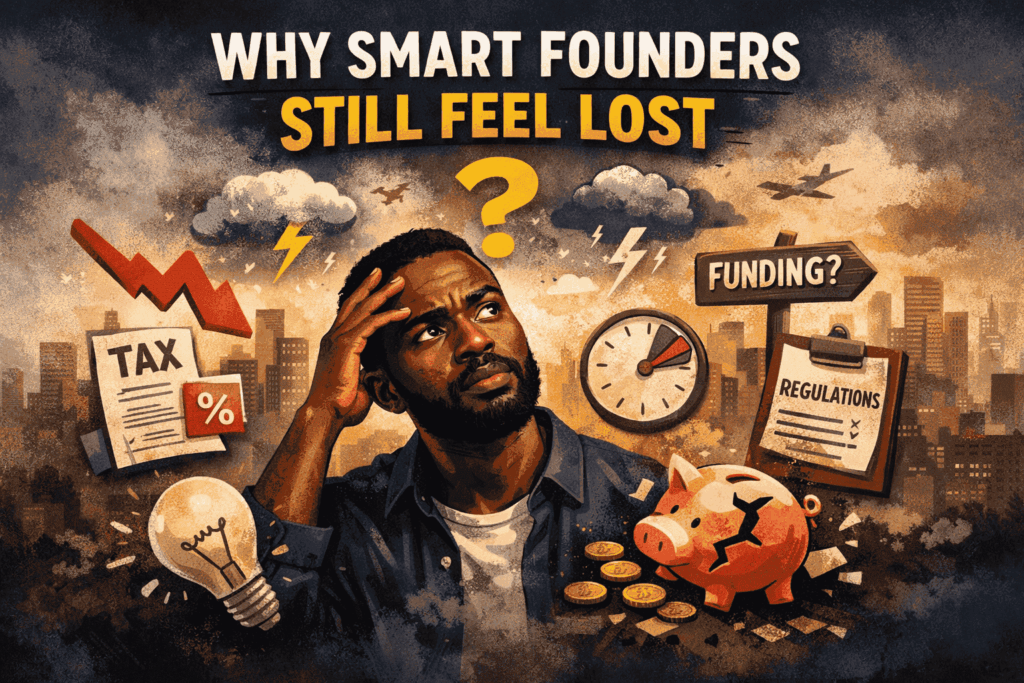
And How Decision Fog Quietly Kills African
Businesses That Look Successful From the
Outside
From the outside, many African startups look strong.
Revenue is growing. The team is capable. Customers are paying. The founder appears confident and in control.
Yet behind closed doors, many founders carry a quiet, persistent feeling they rarely talk about.
Not burnout. Not failure. Not doubt in their intelligence or effort.
Just a subtle sense that something important is missing.
They describe it in different ways:
“We’re doing well, but it doesn’t feel sharp.”
“We’re busy every day, but progress feels slower than it should.”
“I’m making decisions constantly, yet clarity feels further away.”
This article is about that feeling.
It is about why smart African founders still feel lost even when they are doing many things right. And why the real enemy is not execution, funding, or talent, but decision fog.
The African Founder Paradox
African founders operate in one of the most demanding environments in the world.
They build businesses amid:
● Infrastructure gaps
● Regulatory uncertainty
● Currency volatility
● Talent shortages
● Fragmented markets
Because of this, African founders are trained early to be resilient generalists. They learn to handle everything.
Product. Sales. Hiring. Government relations. Customer support. Partnerships. Operations.
This adaptability is a strength.
But at a certain stage, usually when the business begins to scale, that same strength becomes a liability.
Because the founder keeps making every decision, even when the business no longer needs them to.
The result is not chaos.
It is something more subtle.
Fog.
What Decision Fog Really Is
Decision fog is not indecision.
It is the state where:
● You are making many decisions
● But few feel clearly connected to outcomes that matter
● And clarity feels harder to reach the more experienced you become
Founders in decision fog often:
● Collect advice endlessly
● Run multiple experiments at once
● Chase promising ideas that don’t compound
● Feel mentally busy but strategically unsatisfied
They are not lazy.
They are thorough.
But thoroughness without filters creates expensive confusion.
Why Smart Founders Are Especially Vulnerable
Ironically, intelligence increases exposure to decision fog.
Smart founders:
● See many possible paths
● Understand nuance
● Recognize second-order effects
● Are capable of executing multiple strategies
This creates optionality.
And optionality, without a decision framework, creates paralysis.
A McKinsey study on executive decision-making shows that senior leaders make up to 35,000 decisions per day, most of them micro-decisions. Each one depletes cognitive resources.
By the time strategic decisions are required, mental clarity is already drained.
This problem is amplified in African contexts where:
● Systems are less predictable
● Founders must compensate personally
● Delegation feels risky
So founders stay involved.
And decision fog deepens.
African Case Study: The Scaling Fintech Founder (Nigeria)
A Lagos-based fintech founder scaled from 10 to 80 employees in three years.
Revenue grew steadily. Investors were satisfied.
But internally:
● Strategic projects stalled
● The founder felt constantly needed
● The team waited for approvals
An internal audit showed something surprising.
The founder made over 180 decisions per day.
Only 12 were strategic.
The rest were operational:
● Calendar approvals
● Hiring clarifications
● Document reviews
● Meeting attendance
● Communication alignment
Nothing was “wrong.”
But nothing felt clear.
After restructuring decision ownership and systematizing operations, the founder reduced daily decisions to 45, almost all strategic.
Within six months:
● Product velocity increased by 2.5x
● Leadership confidence improved
● Founder stress dropped significantly
Nothing magical changed.
Fog lifted.
Hustle Is Not the Problem
African startup culture often glorifies hustle.
Work harder. Move faster. Do more.
But most founders don’t lack hustle.
They lack filters.
They are surrounded by:
● Growth tactics
● Marketing playbooks
● Fundraising advice
● Scaling frameworks
Yet few tools answer the most important question:
“What should I do next, and does it actually matter?”
Without filters, founders either:
● Freeze
● Or chase everything
Both lead to burnout.
The Founders Who Break Through
Founders who escape decision fog do not become smarter.
They become more selective.
They stop optimizing tactics.
They start questioning relevance.
They ask:
“What are the 2–3 decisions this month that could unlock disproportionate
value?”
This single question eliminates more noise than any growth hack.
Why Boring Founders Win
Here is a counterintuitive truth.
The most innovative founders are boringly systematic.
They do not improvise:
● How meetings are scheduled
● How information flows
● How decisions are documented
● How time is structured
They reserve creativity for:
● Product
● Strategy
● Market positioning
Everything else becomes predictable.
The Cognitive Cost of Operational Chaos
Operational novelty is expensive.
It creates:
- Decision Fatigue
By midday, founders have already burned energy on trivial choices. - Context Switching
Strategic thinking requires depth. Operations demand speed. Mixing both fragments’ focus. - Mental Clutter
Unresolved questions occupy background mental space. - Delayed Innovation
Strategic initiatives stall because operational fires dominate.
Real Example: SaaS Founder Scaling Across Africa
A B2B SaaS founder operating across East and West Africa tracked decisions for 30 days.
Before systematization:
● 3 strategic decisions per day
● 47 operational decisions per day
After operational systems and EA support:
● 12 strategic decisions per day
● 5 operational decisions per day
Innovation velocity quadrupled.
The Role of Executive Assistants in African Scale-Ups
Exceptional Executive Assistants function as novelty elimination systems.
They do not just manage tasks.
They remove decisions.
- Decision Automation
Recurring decisions become zero decisions. - Communication Standardization
Clarity improves while effort decreases. - Time Architecture
Each day has a purpose. - Information Processing
Noise is filtered. Focus is protected.
What the Data Shows
From client data across African and global companies:
● 40% more product releases annually
● 60% faster idea-to-market cycles
● 3x more strategic initiatives completed
● 80% reduction in stalled innovation projects
Systematic operations protect cognitive resources.
Signs Decision Fog Is Holding You Back
● You are busy but shipping slowly
● Strategic projects stall repeatedly
● Ideas sit in notebooks for months
● You are exhausted without breakthroughs
● Your team constantly asks how to handle routine issues
These are not personal failures.
They are system failures.
The Boring Operations Playbook
Weeks 1–2: Identify Repetition
If it happens more than twice, systematize it.
Weeks 3–4: Build Systems
Create standard processes with your EA or ops lead.
Weeks 5–6: Implement
Refine until the routine becomes automatic.
Weeks 7–8: Protect Innovation Space
Schedule strategic thinking deliberately.
Ongoing: Resist New Novelty
Systematize immediately.
The Quiet Feeling Something Is Missing
Many founders experience a subtle discomfort as the company grows.
Not dissatisfaction.
Not doubt.
A sense that the organization has not caught up with the founder’s maturity.
This is not a warning.
It is an insight.
What That Feeling Is Pointing To
Usually one of three things:
- Leadership clarity needs refinement
- Ownership must shift
- Strategy needs a refresh
Strong founders feel this early.
Final Thought
The belief that innovation requires chaos is backwards.
Innovation requires clarity.
Clarity requires fewer decisions.
Systematize what is boring.
Protect what matters.
Smart founders do not fail from lack of effort.
They stall due to a lack of filters.
When decision fog lifts, growth feels lighter.
And leadership becomes what it was meant to be.
Pingback: mobic 15 mg price
Pingback: fluconazole for dogs
Pingback: zoloft no prescription