

Founder Smith Case Study: Gridcare
Introduction
Many early-stage companies experience situations where increasing effort does not produce a proportional increase in results. This often appears in operations, product development, or customer acquisition. In such cases, teams typically respond by increasing resources, adding new features, or expanding infrastructure.
In energy systems, similar patterns can be observed at a larger scale. Electricity grids are designed to match supply and demand across regions. As demand increases, the typical response is to expand generation and transmission capacity.
Gridcare operates within this environment. The company focuses on analyzing electricity grid capacity and identifying areas where existing infrastructure is underutilized.
The company raised $64 million in Series A funding. Its approach is based on analyzing constraints in the grid system rather than building new physical infrastructure.
The following case study describes the context in which this approach exists and the underlying principles behind it.
Electricity Grid Development
Electricity systems are built over long time periods. Planning, permitting, financing, and construction of new infrastructure often take several years. At the same time, electricity demand changes at different speeds depending on region and sector.
In recent years, demand has increased due to several factors, including:
- expansion of renewable energy projects
- growth in electric vehicle adoption
- increased data center activity
- general electrification of industrial processes
These changes have created pressure on existing transmission systems.
In the United States, renewable energy projects are often placed in interconnection queues while waiting for approval to connect to the grid. These queues can extend for multiple years depending on the region and system constraints.
Utilities and system operators respond to these conditions primarily by planning additional infrastructure projects. These projects are intended to increase transmission capacity and reduce congestion.
However, new infrastructure requires long development timelines. As a result, there is often a mismatch between the pace of demand growth and the pace of infrastructure expansion.
Grid demand, capacity, and interconnection queue
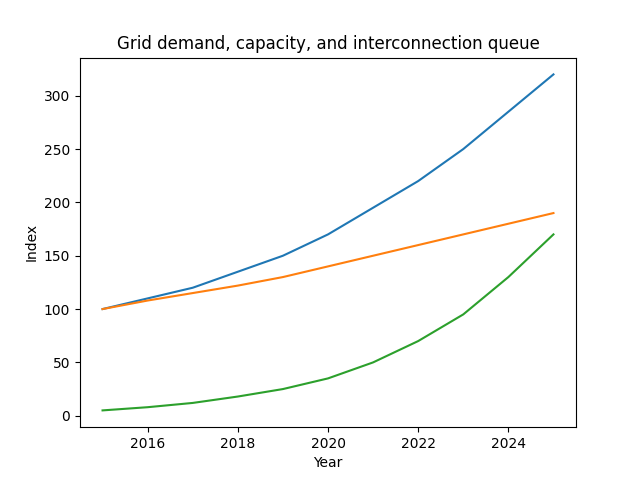
This graphic shows the relative growth of electricity demand, transmission capacity expansion, and interconnection queue length over time.
Standard Approach to Capacity Constraints
The conventional approach to addressing capacity constraints in electricity systems is based on expansion. This includes:
- building new transmission lines
- increasing generation capacity
- upgrading substations and distribution systems
This approach assumes that the primary limitation is physical capacity. Under this assumption, increasing capacity is the primary method for addressing congestion.
This model has been used for decades in energy infrastructure planning.
However, in practice, electricity systems are not only constrained by physical limits. Operational and informational limitations also constrain them.
These include:
- incomplete visibility into real-time capacity usage
- differences in utilization across regions
- inefficiencies in the scheduling and routing of electricity flows
These factors mean that parts of the system may be underutilized while other parts are constrained.
Gridcare Approach
Gridcare operates on the basis that electricity grid capacity is not uniformly used at all times. The system contains variations in utilization across time and geography.
The company applies computational methods and data analysis to identify where unused or underused capacity exists within the grid.
Instead of focusing on building new infrastructure, the approach focuses on identifying available capacity within existing infrastructure.
This involves analyzing:
- transmission line usage
- regional load distribution
- congestion points in the system
- timing differences in electricity demand
The objective is to improve the efficiency of existing grid usage.
This type of approach is often categorized as system optimization rather than infrastructure expansion.
Build new infrastructure vs optimize existing system
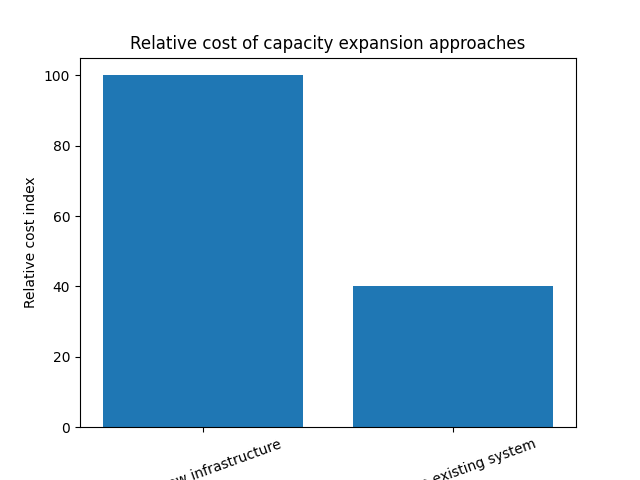
This graphic compares the relative costs of building new infrastructure versus optimizing existing systems.
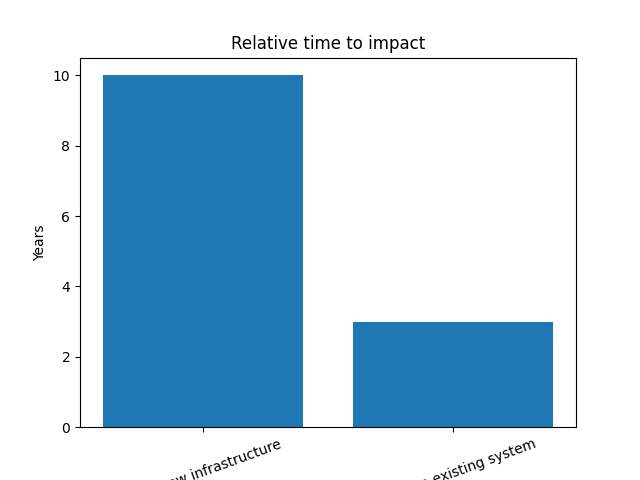
This graphic compares the time required for implementing new infrastructure versus optimization-based approaches.
Concept of Hidden Capacity
Electricity grids contain variations in utilization due to several structural factors:
- regional demand differences
- transmission constraints between zones
- timing mismatches in generation and consumption
- regulatory and operational boundaries
As a result, some portions of the grid operate below maximum capacity while others experience congestion. This difference is sometimes referred to as hidden or unused capacity. Gridcare focuses on identifying these areas using data-driven analysis.
The concept of hidden capacity applies broadly to infrastructure systems beyond electricity. Similar patterns can be observed in logistics, telecommunications, and financial systems. In these systems, constraints are not always the result of absolute scarcity. They can also result from uneven distribution of usage.
Relevance to Startup Systems in African Markets
Many startups operating in African markets function in environments where resource constraints are common. These constraints include:
- limited capital availability
- infrastructure gaps
- uneven service distribution
- high variability in demand
In such environments, growth strategies often focus on expansion of resources. This includes hiring more staff, expanding service coverage, or adding new product lines.
However, in many cases, growth is also influenced by how existing resources are used.
Examples include:
- delivery systems where routing efficiency affects capacity
- financial platforms where onboarding friction affects transaction volume
- agricultural platforms where distribution timing affects output
- marketplaces where conversion rates depend on matching efficiency
In each case, system performance depends on utilization of existing structures.
Gridcare’s approach reflects a similar principle applied at an infrastructure scale.
System capacity utilization
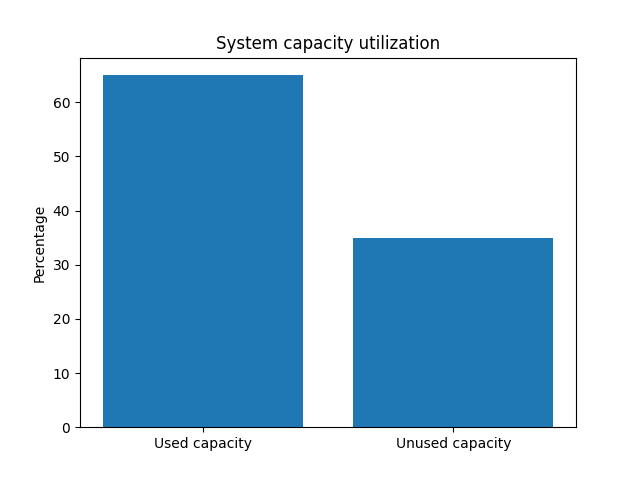
This graphic shows the distribution between used and unused system capacity.
Investment Context
Gridcare raised $64 million in Series A funding from investors including Sutter Hill Ventures, Acclimate Ventures, Aina Climate AI Ventures, and Clearvision Ventures.
Investment in this category reflects interest in software-based approaches to infrastructure systems.
Rather than focusing only on physical expansion, some investors allocate capital to tools that improve the utilization of existing systems.
In infrastructure-heavy sectors, small efficiency improvements can produce large aggregate effects due to system scale.
System-Level Interpretation
Gridcare’s model represents a category of approaches in which system constraints are addressed through analysis and reallocation rather than expansion.
This type of approach depends on several conditions:
- availability of sufficient system data
- ability to model complex interactions within infrastructure networks
- presence of uneven utilization across system components
In environments where these conditions exist, optimization approaches can be applied alongside traditional infrastructure expansion.
Comparative Observations
Across different sectors, similar patterns can be observed:
- Transportation systems where route optimization improves capacity without additional vehicles
- Cloud computing systems, where resource allocation affects performance efficiency
- Financial systems where liquidity distribution affects access to capital
These examples share a common structure in which system performance is influenced by allocation rather than absolute capacity.
Implications for Infrastructure Planning
Traditional infrastructure planning prioritizes expansion to meet projected demand. This includes long-term capital investment in physical assets.
Optimization-based approaches introduce an additional layer of analysis focused on improving utilization of existing assets.
These two approaches are not mutually exclusive. In practice, they often operate in parallel.
Expansion addresses long-term structural constraints.
Optimization addresses short-term and medium-term inefficiencies.
Conclusion
Gridcare operates within the context of electricity grid management and focuses on identifying unused capacity within existing infrastructure.
The company applies data analysis to improve visibility into how electricity systems are utilized.
The broader implication of this approach is that system constraints are not always due to insufficient capacity. In some cases, they result from uneven utilization of existing capacity.
This distinction is relevant in infrastructure systems and other domains where resource allocation affects system performance.
Takeaway
Before increasing resources in a system, it is useful to examine how existing resources are being used and whether utilization is consistent across the system.