
A Founder Smith Case Study on Topsoe, Timing, and the Cost of Holding On
Introduction
Growth stories are often told through addition.
New products. Expanded markets. Increased capacity.
These are visible signals measurable through announcements, funding rounds, and facility openings.
But subtraction tells its own story. A product discontinued. An expansion paused. A facility operating below expectations.
These decisions rarely make headlines because they are harder to interpret. Growth feels intuitive; restraint feels uncertain. Yet, in practice, every organization eventually faces a moment when the challenge is not identifying opportunity but deciding how to respond when opportunity unfolds at a different pace than expected.
Topsoe’s experience captures this tension: a company preparing for the hydrogen economy, then confronting the reality that timing can be as decisive as technology.
Context: Hydrogen’s Promise and Patience
During the late 2010s and early 2020s, hydrogen became a central theme in climate and industrial policy.
Governments launched national hydrogen strategies.
Investors funded pilot projects.
Industrial giants announced hydrogen‑based operations.
Forecasts multiplied, and optimism grew.
The appeal was clear.
Hydrogen offered a pathway to decarbonize sectors that electricity alone could not easily reach — steel, chemicals, shipping, and heavy transport.
It could serve as both fuel and feedstock, bridging the gap between renewable generation and industrial demand.
As enthusiasm spread, project announcements surged across Europe, North America, Asia, and parts of Africa.
Consulting reports projected exponential growth.
Financial institutions began modeling hydrogen’s role in future portfolios.
The direction seemed certain; only the timeline was unclear.
Global Hydrogen Project Announcements (2018–2025)
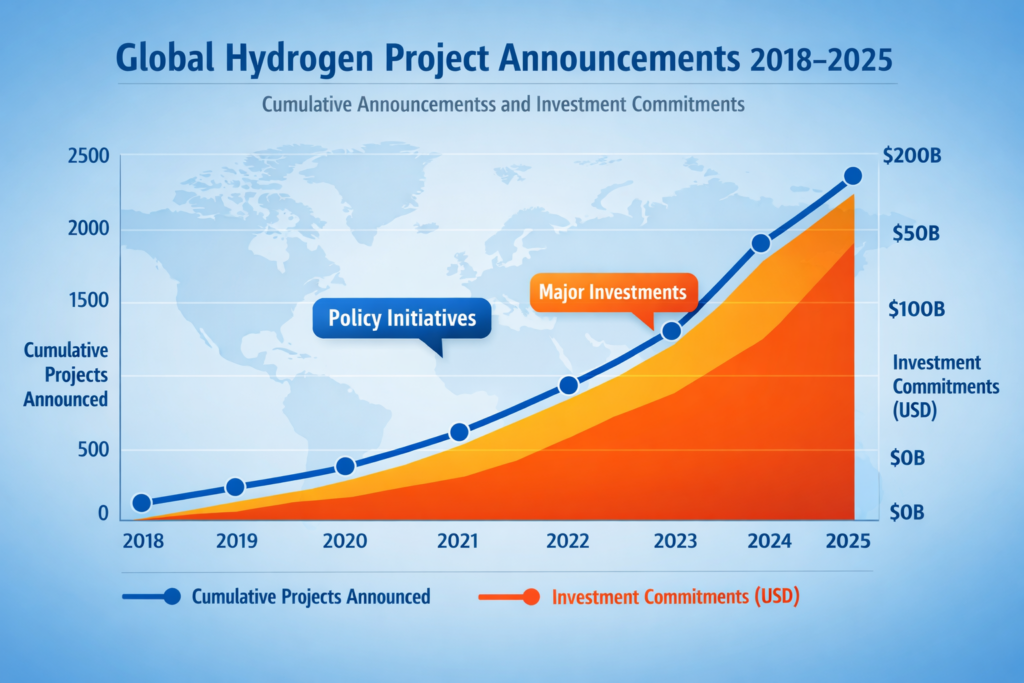
Line chart showing cumulative hydrogen project announcements and investment commitments over time.
Caption: Hydrogen project announcements increased sharply as governments and corporations developed long‑term decarbonization strategies.
Strategic Question: When to Build
For companies supplying equipment to the hydrogen sector, the question was timing.
If demand was expected to rise substantially, when should manufacturing capacity expand?
Waiting too long risked missing future orders.
Expanding too early risked idle facilities.
Topsoe, with decades of experience in industrial catalysts and process technologies, saw hydrogen as a natural extension of its expertise.
Electrolyzers: systems that split water into hydrogen and oxygen using electricity became the centerpiece of this opportunity.
When powered by renewables, they produce “green hydrogen,” a cornerstone of low‑carbon industry.
Encouraged by forecasts and policy momentum, Topsoe invested ahead of demand.
Manufacturing capacity was developed to support large‑scale deployment.
The rationale was sound:
- Hydrogen demand was expected to grow.
- Industrial decarbonization targets were tightening.
- Governments were offering incentives.
- Renewable electricity generation was expanding.
Taken together, these signals suggested a market ready to accelerate.
The Reality of Slow Acceleration
Industrial transitions, however, rarely move in straight lines.
Projects depend on interconnected factors: infrastructure, financing, permits, supply chains, and policy stability.
When one slows, the entire system feels it.
Hydrogen projects faced these interdependencies.
Announcements outpaced construction.
Some advanced; others stalled.
Energy prices fluctuated.
Financing conditions shifted.
Permitting delays accumulated.
The result was a widening gap between long‑term potential and short‑term activity.
Manufacturers found themselves with capacity built for a future that had not yet arrived.
Hydrogen Project Development Pipeline
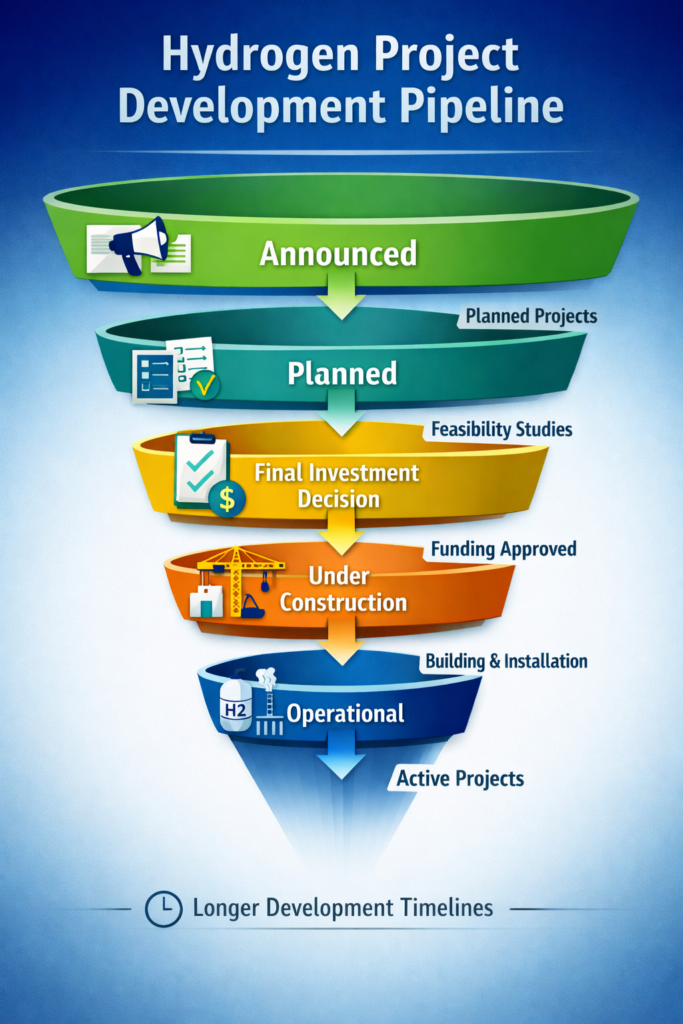
Funnel chart showing stages — Announced → Planned → Final Investment Decision → Construction → Operational.
Caption: Many hydrogen projects progressed through development stages more slowly than anticipated, creating differences between announced activity and operational deployment.
Timing and Utilization
For manufacturers, timing directly affects utilization. Facilities are designed for expected production volumes. If customer demand develops more slowly, utilization rates fall.
This does not invalidate the opportunity; it simply changes the rhythm of growth.
Organizations can be right about the future and still wrong about the present.
Topsoe’s situation reflected this nuance. The company had invested in infrastructure aligned with long‑term hydrogen demand. Governments remained supportive. Industrial customers continued exploring projects. But deployment timelines stretched.
Each quarter brought small delays, postponed orders, revised forecasts, and deferred investment decisions.
Individually manageable, collectively significant.
Over time, the company faced a question familiar to many in emerging industries:
Do we continue at the same pace, or do we adjust to the market’s tempo?
Adjustment and Duality
Topsoe eventually announced plans to place portions of its electrolyzer manufacturing operations into hibernation and suspend certain expansions. Externally, this seemed at odds with earlier optimism.
Internally, it was a recalibration, a shift from direction to timing.
The company’s long‑term view of hydrogen remained intact. But its near-term strategy adapted to reality.
This distinction matters: organizations can believe in the future while adjusting to the present.
Interestingly, during the same period, Topsoe also announced its participation in a major electrolyzer supply agreement for a green ammonia project in South Africa. Restraint and opportunity coexisted.
One decision reflected caution; the other, confidence. Together, they illustrated the complexity of emerging industries where progress and patience often share the same stage.
Manufacturing Capacity and Market Demand
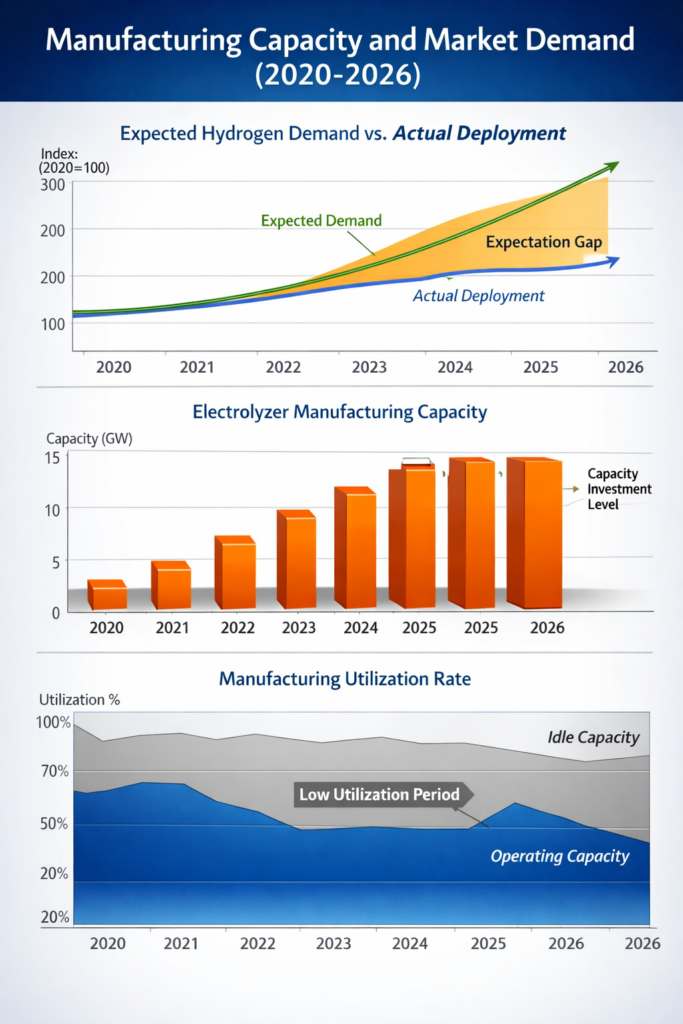
Line chart comparing expected demand trajectory, actual market deployment, and manufacturing capacity investments (2020–2026).
Caption: Differences between projected adoption timelines and realized deployment can create periods where manufacturing capacity exceeds current market activity.
The Psychology of Adjustment
Strategic shifts are rarely just operational; they are psychological. When companies commit significant resources to a vision, changing course feels uncomfortable.
Facilities have been built. Teams assembled. Expectations set.
Momentum creates emotional gravity. Leaders want earlier assumptions to prove correct. They want projects to succeed as planned. They want validation for past decisions.
Yet, adaptation is not failure; it is evidence of awareness. Recognizing when timing diverges from expectation is a mark of maturity, not retreat. In volatile sectors, flexibility becomes a competitive advantage.
Parallel Lessons for Founders
For founders in African markets, the specifics of hydrogen technology may seem distant, but the underlying dynamic is familiar.
Growth decisions often rely on assumptions about future demand:
- Hiring additional staff.
- Expanding into new regions.
- Developing new products.
- Acquiring infrastructure.
Sometimes those assumptions materialize; sometimes they don’t.
When conditions evolve differently, organizations face choices about resource allocation.
The challenge is rarely finding the “right” answer.
It is maintaining the discipline to revisit assumptions without losing conviction.
Announcements attract attention; adjustments rarely do.
Yet both shape a company’s trajectory.
Systemic Parallels
Across industries, similar patterns appear:
- Technology: Platforms scale faster than user adoption.
- Retail: Expansion outpaces local demand.
- Manufacturing: Capacity exceeds near‑term orders.
- Finance: Liquidity pools unevenly across markets.
Each case reveals the same principle: growth is not only about addition but also about alignment.
The ability to pause, reassess, and redirect resources determines long‑term resilience.
Reframing Reduction
Reduction is often misread as retreat.
In reality, it can be a form of optimization.
When organizations slow expansion, they create space for reflection, efficiency, and recalibration.
They preserve optionality, the ability to act when conditions improve.
Topsoe’s decision to hibernate part of its manufacturing capacity was not a rejection of hydrogen’s promise.
It was an acknowledgment that markets mature unevenly.
By adjusting pace, the company maintained readiness for future acceleration without overextending in the present.
The Broader Implication
Emerging industries evolve through cycles of enthusiasm and correction.
Forecasts surge, then stabilize. Capital flows in waves. Policy support fluctuates.
Each cycle tests whether organizations can distinguish between structural opportunity and temporal noise.
Topsoe’s experience demonstrates that strategic patience can coexist with ambition.
The company continues to invest in research, partnerships, and long‑term projects but with a clearer sense of timing. This balance between optimism and realism defines sustainable innovation.
Take-Home: The Discipline of Timing
- Growth is not linear.
Expansion and contraction are both part of progress. - Timing matters as much as direction.
Being early can be as costly as being late. - Adjustment is not failure.
It is evidence of responsiveness and strategic maturity. - Momentum must be managed.
Past investments create inertia; leaders must separate commitment from attachment. - Duality defines transition.
Opportunity and restraint often coexist; learning to hold both is essential. - Visibility favors addition; sustainability favors reflection.
The decisions that preserve long‑term health are often the least visible.