Founder Smith Case Study: Antora Energy + POET
Introduction
Every founder knows the uneasy moment when belief costs more than proof.
You buy equipment before revenue arrives.
You hire before growth appears.
You expand before certainty exists.
It is the quiet tension between conviction and cash flow, a space where progress feels invisible but necessary.
Antora Energy’s story captures this moment with clarity.
The company builds thermal batteries that store renewable electricity as heat, allowing factories to operate without fossil fuels.
Its early years were defined by one difficult decision: investing heavily in manufacturing capacity long before the market was ready.
This case study explores that decision, the discomfort it created, and the eventual payoff that followed.
It also reflects a truth familiar to African founders that growth often begins with sacrifice.
Context: Industrial Patience
Industrial innovation rarely moves at startup speed.
Factories depend on contracts, not prototypes.
Customers demand reliability, not experiments.
And yet, climate‑driven industries require leaps of faith, building infrastructure before demand fully materializes.
Antora faced this dilemma in 2021.
Its technology worked.
Pilot projects showed promise.
But large‑scale adoption required physical assets: furnaces, heat exchangers, and storage modules.
Waiting would preserve capital.
Building would prove readiness.
The team chose to build.
The decision was not impulsive. It was grounded in a belief that industrial customers would soon demand reliable, zero‑carbon heat and that readiness would matter more than timing.
Short‑Term Pain vs Long‑Term Value
Early investment created short‑term financial strain but positioned Antora for long‑term efficiency and market leadership.
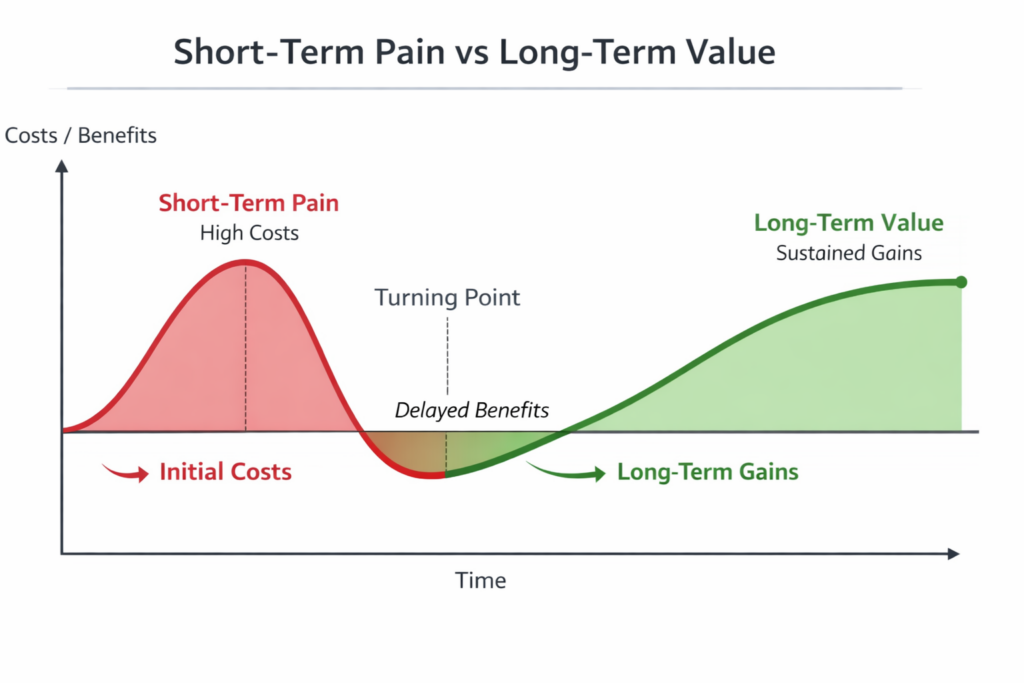
A curve showing an initial cost spike followed by delayed benefits and eventual long‑term gains.
The Decision
Antora committed millions to equipment and facility expansion.
For months, expenses rose while revenue stayed flat.
Investors questioned timing.
Analysts called it premature.
Inside the company, morale wavered.
But the leadership team held its ground.
They believed that industrial customers would soon need reliable, clean heat — and that being ready would matter when the market turned.
It was a bet on inevitability rather than immediacy.
The company’s founders understood that the cost of waiting could be greater than the cost of acting early.
This kind of decision is rarely celebrated.
It feels uncomfortable, even reckless.
But it often separates those who prepare from those who react.
The Turning Point
By mid‑2023, global energy prices spiked.
Factories began searching for alternatives to natural gas.
Suddenly, Antora’s early investment looked prescient.
The company could deliver at scale while competitors were still prototyping.
The pain of early spending transformed into an advantage.
The same decision that hurt first became the reason they could respond fast later.
Antora’s readiness allowed it to secure contracts that others could not fulfill.
Its facilities, once seen as premature, became the foundation for growth.
The lesson was simple but profound: timing is not only about prediction; it is about preparation.
Industrial Energy Costs Over Time
Energy price fluctuations validated Antora’s early investment in stable, renewable heat infrastructure.
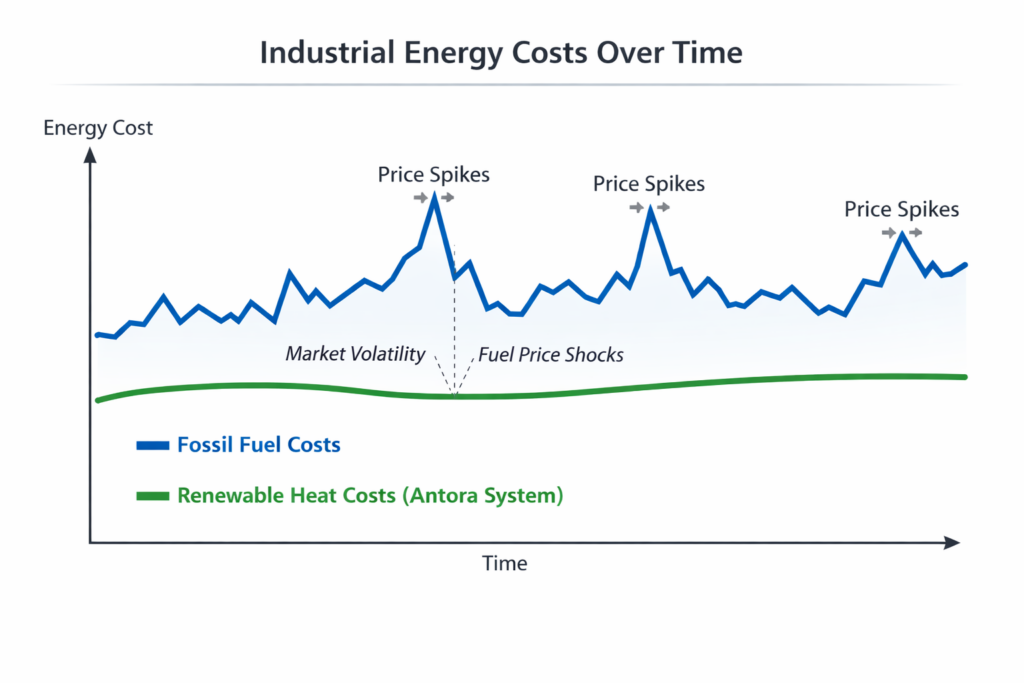
A line chart comparing fossil fuel cost volatility with stable renewable heat cost from Antora’s system.
Parallel Lesson: POET’s Efficiency Gamble
Around the same time, POET, one of the world’s largest biofuel producers, faced a similar dilemma.
It invested in process optimization and carbon-capture retrofits before regulatory incentives were finalized.
The upgrades strained budgets but later positioned POET to benefit from new clean‑fuel standards.
Both companies demonstrated the same principle: efficiency investments often look irrational until conditions change.
In both cases, the founders acted before the market rewarded them.
They endured discomfort to secure future advantage.
They understood that progress sometimes requires patience disguised as pain.
African Founder Relevance
African founders face this same tension daily.
You hire before revenue.
You buy equipment before contracts.
You expand before certainty.
Whether it is a logistics startup in Lagos buying delivery bikes ahead of demand or an agritech platform in Nairobi investing in cold‑chain storage before farmers commit, the logic is identical.
Early investment hurts.
But readiness pays.
In markets where infrastructure is limited and conditions change quickly, being prepared often determines survival.
The founders who build early are the ones who can respond when opportunity arrives.
This is not about risk for its own sake.
It is about understanding that timing is not only external but also internal.
It is the rhythm between belief and execution.
Cost of Waiting vs Cost of Acting
Acting early incurs visible cost; waiting incurs invisible loss. Founders must choose which pain they prefer.
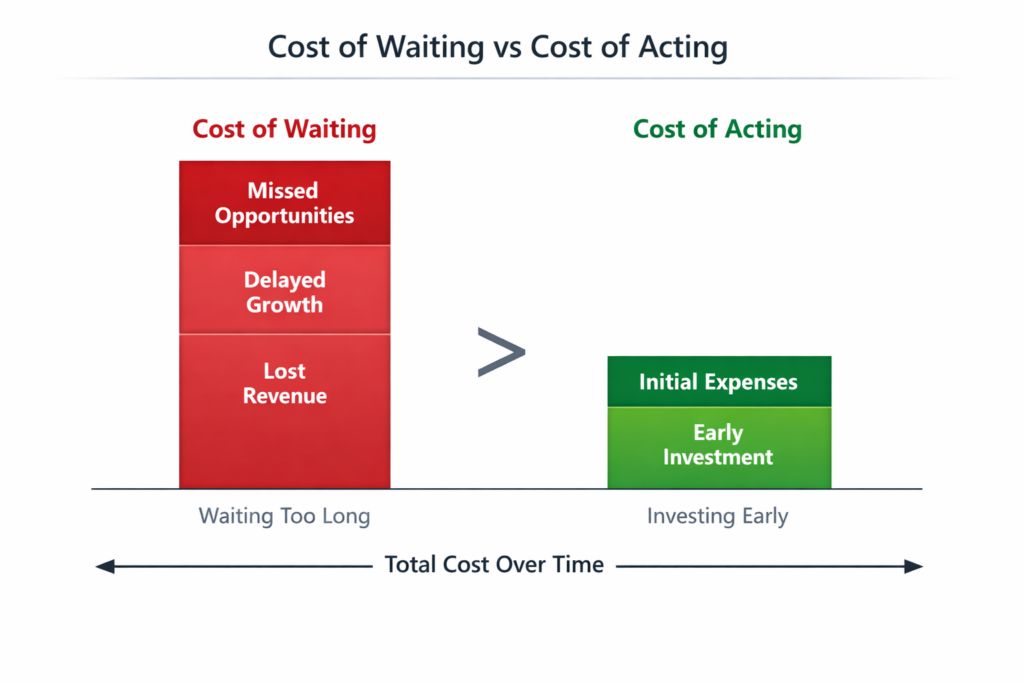
A comparative bar chart showing cumulative opportunity loss from waiting versus the upfront cost of acting early.
The Emotional Side of Early Decisions
Financial models can explain cost and return, but they cannot capture emotion.
The hardest part of early investment is not the money; it is the uncertainty.
You spend months watching numbers move in the wrong direction.
You hear questions that sound reasonable but feel discouraging.
You wonder if conviction has become stubbornness.
For founders, this is the quiet test of leadership.
It is the moment when vision must carry weight without evidence.
Antora’s founders described this period as “the valley between belief and proof.”
They knew the technology worked, but they could not yet prove that the market would respond.
They built anyway.
That decision required courage, not the loud kind, but the steady kind that endures silence.
Systemic Reflection
Across industries, similar patterns appear.
In technology, startups invest in servers before users arrive.
In retail, brands open stores before demand stabilizes.
In manufacturing, capacity often exceeds near‑term orders.
Each case reveals the same principle: growth is not only about addition but also about alignment.
The ability to pause, reassess, and redirect resources determines long‑term resilience.
Antora’s story is not about energy; it is about endurance.
It shows that progress often begins with discomfort and that the most valuable assets are built during uncertainty.
African Market Parallels
In African markets, delayed gratification is not a theory; it is a daily reality.
Founders operate in environments where infrastructure is incomplete, financing is limited, and timelines are unpredictable.
They must often act before conditions are ideal.
A fintech founder in Accra may invest in compliance systems before regulation matures.
A healthtech startup in Kigali may build offline functionality before connectivity improves.
A logistics company in Lagos may expand routes before customers fully commit.
Each decision carries risk.
Each decision also builds readiness.
The lesson is not to spend recklessly but to understand that preparation has a cost and that cost is often the price of opportunity.
The Broader Implication
Emerging industries evolve through cycles of enthusiasm and correction.
Forecasts surge, then stabilize.
Capital flows in waves.
Policy support fluctuates.
Each cycle tests whether organizations can distinguish between structural opportunity and temporal noise.
Antora’s experience demonstrates that strategic patience can coexist with ambition.
The company continues to invest in research, partnerships, and long‑term projects but with a clearer sense of timing.
This balance between optimism and realism defines sustainable innovation.
It is not about predicting the future; it is about preparing for it.
Take‑Home: The Discipline of Early Pain
- Readiness beats reaction.
Build before the market calls if conviction is grounded in evidence. - Short‑term discomfort is strategic.
Pain is not failure; it is preparation. - Capital efficiency is not always capital delay.
Spending early can be efficient when timing aligns with inevitability. - Every founder must choose their pain.
The cost of acting early versus the cost of arriving late. - Patience is not passive.
It is the quiet form of progress that builds strength before visibility.
Antora Energy and POET remind us that growth often begins with discomfort and that the hardest decisions are sometimes the most profitable ones.
For African founders, the message is simple but enduring:
Build when it feels early. Hold when it feels uncertain. Wait until it feels right.
Because the decision that hurts first may be the one that pays later.