
Why rapid execution needs deliberate pacing lessons for African founders
When starting a business, speed often feels like everything. Founders across Africa, from Lagos and Nairobi to Accra and Cape Town, face immense pressure to execute quickly. Launch the product, acquire users, impress investors, and “disrupt” your sector. Early wins create excitement. Dashboards light up. Media attention arrives. It feels like momentum.
But here’s the crucial truth: speed without strategy can be dangerous. Acting fast without deliberate planning can create operational inefficiencies, burn cash, frustrate customers, and even destroy credibility. The key is to build fast but move slowly.
Building fast is about experimentation, learning, and testing assumptions. Moving slowly is about deliberate decision-making that ensures execution turns early traction into sustainable growth. For African founders, this balance is essential. Market volatility, limited capital, and infrastructure gaps mean missteps are costly.
Zero Homes: A Case Study in Balanced Growth
Zero Homes, a Denver-based digital-first home upgrade platform, raised $17 million in Series A funding. Their mission was to scale energy-efficient home solutions using software and data.
- Building Fast: They quickly deployed pilot software, tested workflows, and collected user feedback. Early adoption indicated demand.
- Moving Slow: Scaling required careful systems for contractor onboarding, customer data accuracy, and service reliability. Each operational detail had to function before broader market expansion.
For African founders, this approach is highly relevant. Whether launching fintech, health-tech, agritech, or energy solutions, early experimentation must be paired with deliberate operational planning. Rapid adoption is exciting, but momentum comes from systems and sustainable processes.
The Risk of Speed Without Strategy
Fast execution often feels productive, but it can be deceptive. Startups frequently confuse early traction with long-term momentum. Common pitfalls include:
- Operational inefficiency: Teams struggle with rapid expansion, causing delays and errors.
- Customer churn: Users leave if the product or service fails to scale.
- Cash burn: Rapid spending without stable revenue drains the startup’s runway.
- Regulatory missteps: Scaling without compliance can trigger legal or market challenges.
- Product-market misalignment: Features built quickly may fail to meet broader market needs.
African founders can use this chart to anticipate where moving too fast without deliberate planning is likely to create problems.
Startup Statistics That Reinforce the Lesson
Data shows the dangers of prioritizing speed without strategic pacing:
- 90% of startups fail, often due to operational mismanagement or poor scaling.
- 30% fail within 2 years and 50% within 5 years, frequently after early traction.
- Only 7% reach $10 million in revenue, highlighting the gap between early wins and sustainable growth.
- Early scaling missteps like poor retention, operational gaps, and regulatory challenges are leading causes of failure.
For African startups, these statistics reinforce the need to balance speed with careful scaling to maximize survival and long-term impact.
The Build Fast, Move Slow Philosophy
The principle is simple: act quickly to learn, act deliberately to scale.
- Build Fast: Rapid prototyping, pilot testing, and experimentation help founders validate assumptions cheaply and efficiently.
- Move Slow: Strategic decisions around hiring, operations, infrastructure, compliance, and scaling require deliberate pacing.
African founders face challenges that make deliberate speed essential:
- Infrastructure variability: Power, internet, and logistics gaps require careful operational planning.
- Regulatory diversity: Laws and policies differ across countries and regions.
- Behavioral diversity: Customers respond differently across markets.
- Limited capital: Missteps are more costly when access to investment is constrained.
By building fast for learning and moving slow for scaling, startups reduce risk while maximizing growth potential.
Operational Excellence as a Growth Lever
Zero Homes’ success relied on operational discipline. Rapid pilot deployment generated early traction, but systems and processes allowed scalable execution. African founders can take the following lessons:
- Develop repeatable workflows for onboarding customers, partners, and vendors.
- Implement operational checkpoints to monitor quality, reliability, and compliance.
- Train teams gradually to avoid inefficiencies from rapid hiring.
- Establish feedback loops to improve processes before expanding further.
These steps turn early traction into long-term momentum.
Financial Discipline
Fast execution often drives rapid spending. Cash mismanagement is a leading cause of startup failure. African founders must plan their runway carefully:
- Monitor burn rate vs. revenue constantly.
- Maintain buffer capital for deliberate scaling steps.
- Avoid premature hiring until demand is validated.
- Use phased rollout strategies to control costs.
Zero Homes demonstrates that building fast in pilot regions while moving slowly in expansion preserves resources and maintains operational reliability.
Customer Retention as a Momentum Engine
Momentum is rooted in repeat users. Traction alone is insufficient. African startups can improve retention through:
- Structured customer engagement programs via mobile apps, SMS, or email.
- Tracking cohort retention to evaluate long-term engagement.
- Continuous feedback collection for product improvements.
- Ensuring service reliability, especially where infrastructure is variable.
By moving slowly in operations while building fast in product iteration, startups create loyal users who generate sustainable growth.
Scaling Across African Markets
Expansion presents unique challenges:
- Infrastructure gaps: Power outages, connectivity issues, and transport limitations.
- Regulatory complexity: Country-specific rules require patience and careful navigation.
- Cultural diversity: User needs and behaviors vary across regions.
Rapid experimentation tests hypotheses, but scaling demands deliberate systems and adaptation. Zero Homes scaled cautiously, ensuring operational consistency before broad rollout, a lesson African founders can emulate.
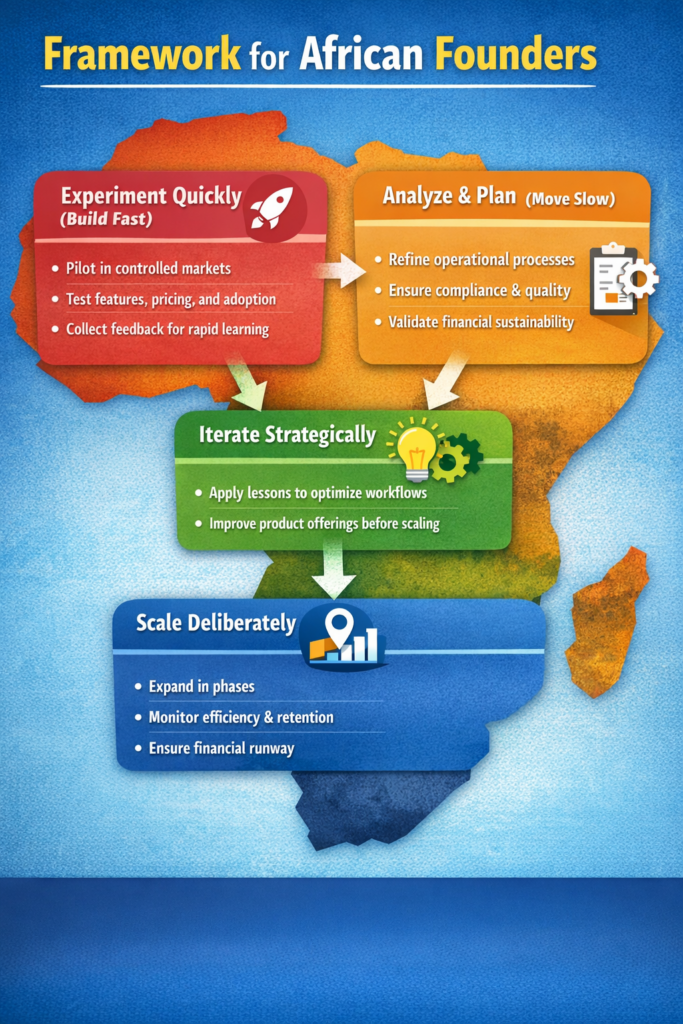
Framework for African Founders
This framework ensures speed in learning does not exceed the startup’s capacity to scale sustainably.
African Startup Examples
- Fintech in Lagos: Mobile payments startup learns from pilot users before expanding to multiple neighborhoods. Strategic pacing ensures regulatory compliance and operational reliability.
- Solar Energy in Tanzania: Mini-grid deployment tested in select villages. Deliberate scaling ensures that technician training, payment systems, and regulatory adherence are in place before expansion.
- Health-Tech in Nairobi: Telemedicine app pilots quickly with early adopters. Gradual system improvements reduce appointment failures and increase user retention.
- Agri-Tech in Ghana: Digital farm advisory platform tests crop recommendations with select farmers before rolling out across regions. Ensures operational readiness and local adaptation.
Each case reinforces that building fast without moving slow creates risk. Deliberate, measured execution preserves early wins and drives momentum.
Takeaways for African Founders
- Early traction is not momentum: Validation signals interest, not guaranteed growth.
- Momentum requires operational discipline: Systems, processes, and training are essential.
- Financial management is critical: Careful budgeting prevents cash crises during rapid growth.
- Retention is key: Repeat users sustain growth.
- Market adaptation matters: Local infrastructure, regulation, and culture influence scalability.
Conclusion
Building fast is exhilarating. Moving slowly is deliberate. African founders must combine these principles to navigate complex markets successfully. Early wins provide proof, but deliberate pacing ensures sustainability.
Zero Homes exemplifies this duality: rapid pilot deployment generated insights, while measured scaling turned those insights into momentum.
For African startups, this philosophy can be the difference between excitement that fizzles and traction that transforms into a lasting, impactful enterprise.
By building fast to learn and moving slow to scale, African founders can achieve growth that is both rapid and sustainable, turning early promise into long-term success.


Pingback: When Users Come but Money Doesn’t - Founders Smith
Pingback: Fundraising vs. Bootstrapping - Founders Smith