
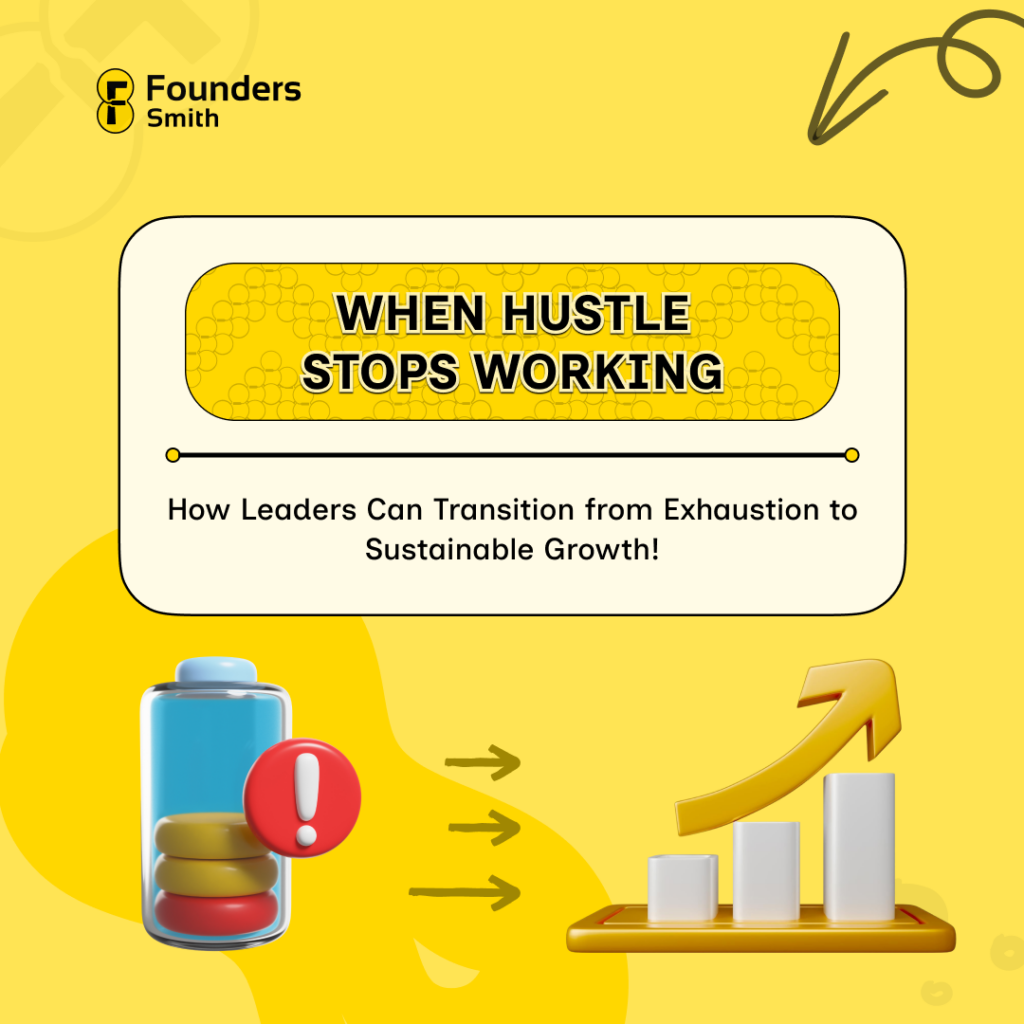
For many founders, hustle is inseparable from entrepreneurship. “Work harder, grind longer, and outwork everyone.” These mantras fuel ambitious early stages and are embedded in startup mythology. But what happens when hustle stops working? What then?
In the early years, hustle can deliver amazing momentum, rapid iteration, and that sense of “we’re unstoppable”… until we’re not. But once complexity grows, teams expand, markets fragment, investors expect strategic leadership, raw effort becomes less effective, and sometimes even counterproductive.
This shift is real, and leaders are confronting it head‑on. The traditional “hustle hard” model, firing on all cylinders until something breaks, is giving way to something far more strategic: leadership by intentional design, structured systems, and outcomes over effort.
Let’s explore why hustle stops working, what it reveals about leadership and systems, and how founders can transition from effort‑centric practices to sustainable growth engines that deliver real impact without burning out.
1. The Myth of Hustle: Why It Eventually Stops Working
Hustle gets celebrated because it feels productive. The founder pulling long hours, juggling tasks, and answering every call, that’s the iconic image. But research and real founder experiences show the following:
- Effort does not scale linearly with output beyond a certain point.
- Productivity increases with structure and focus, not longer hours.
- Prolonged hustle eventually leads to diminishing returns and burnout.
Hustle isn’t the problem when you’re small; it’s often necessary to survive. But as your business grows, complexity increases. What once worked as a short‑term tactic becomes a limit, not an advantage.
1.1 Hustle vs. Productivity: The Evidence
Research has shown that productivity actually declines steeply after around 50 hours of work per week, with negligible gains beyond 55–60 hours.
This happens because:
- Cognitive performance drops with exhaustion
- Focus becomes fragmented
- Decision quality deteriorates
- Strategic thinking becomes impaired
Hustle culture celebrates busywork and constant activity but rarely prioritizes deep work, intentional execution, or long‑term strategy.
To borrow a line from modern entrepreneurship critiques: hustle feels like progress, but it often creates more noise than momentum.
1.2 The Hidden Cost: Burnout Isn’t Just Individual, It’s Organizational
Burnout doesn’t just affect founders individually. It seeps into teams and company culture:
- Teams mirror exhaustion modeled by leaders
- Decision‑making crashes under stress
- Innovation declines when minds are overworked
- People become less creative and more reactive
- Emotional intelligence, crucial for leadership, drops
Burnout is not a personal failure; it’s a signal that hustle alone is not a sustainable strategy.
2. Leadership vs. Hustle: Shifting the Founder Mindset
When hustle stops working, leaders don’t suddenly need less effort; they need different effort. The shift requires a move from acting like solo operators to becoming designers of organizations and environments that scale.
2.1 From Hustle to Intentional Leadership
The critical transition for leaders is moving from doing everything to designing systems that work. Hustle is about doing more. Leadership is about leading others to do better.
This means:
- Prioritizing systems over spontaneous effort
- Focusing on outcomes, not hours
- Delegating strategically
- Removing firefighting in favor of prevention
- Aligning team effort around shared purpose
The leaders who thrive in this new paradigm spend less time “putting out fires” and more time shaping the structure that prevents fires in the first place.
In essence, hustle becomes a tool, not the engine.
2.2 Structure vs. Hustle: Why Systems Win
Hustle relies on individuals’ energy, focus, and willpower. Systems, by contrast, embed repeatable logic, processes, and clarity into the organization. The difference is profound:
| Hustle (Reactive) | System (Strategic) |
| Dependent on individual energy | Independent of energy levels |
| Short burst wins | Long‑term sustainability |
| Firefighting | Prevention and clarity |
| Variable outcomes | Predictable outcomes |
| Reaction | Strategy |
Systems are not antithetical to hustle; they amplify it. Hustle without systems is heat; hustle with systems is horsepower.
For founders, this transition often happens unconsciously until hustle no longer produces results. Only then does the need for structure become undeniable.
3. Outcome Over Effort: Leading With Results, Not Hours
One of the subtle shifts leaders need to make is from effort‑centric metrics to outcome‑centric metrics. Growth doesn’t happen because someone logged more hours. It happens because the right outcomes were achieved.
This means shifting the measurement from
- Hours worked, tasks completed, meetings attended
to - Value delivered, goals achieved, strategic milestones met
Outcomes provide clarity and focus. Effort without outcomes often results in busy calendars and little strategic movement, a hallmark of ineffective hustle.
3.1 What Effective Outcome Measurement Looks Like
Instead of:
- “I worked a 12‑hour day.”
- “I replied to all emails.”
- “I attended every meeting.”
Focus on:
- What measurable value was delivered?
- Did the activity move the business forward?
- Were strategic priorities achieved?
- Did this deepen team alignment or customer success?
This shift requires discipline because it challenges deeply held assumptions about productivity. But it’s essential for sustainable leadership.
Significant research shows that time logged does not equate to value created, especially beyond a certain threshold of effort.
4. Intentional Design: Build the Environment Before You Chase Growth
Now that we’ve discussed why hustle stops working and what to focus on instead, it’s time to explore how founders can build structures that scale.
Intentional design means creating workflows, decision rules, team norms, and systems that align energy with measurable outcomes. It’s the difference between reactionary hustle and planned execution.
4.1 Design Your Environment for Success
Designing your work environment, physical and organizational, is strategic work:
- Define work hours and norms (e.g., no meetings during deep work blocks)
- Create rules that protect strategic time (e.g., focus mornings for thinking)
- Establish accountability systems (clear milestones, targets, dashboards)
- Measure outcomes, not activity
This isn’t about eliminating effort; it’s about structuring effort so it produces consistently.
5. Leadership Leverage: Delegation, Systems, and Energy Management
When hustle stops working, the leader’s role evolves from individual contributor to architect of leverage. Leverage means getting more impact with less direct effort by enabling systems and people to do work for you.
5.1 Delegating Outcomes, Not Tasks
Delegation is not just handing off work; it’s transferring responsibility for results.
Good delegation includes the following:
- Clear expectations
- Defined success criteria
- Authority
- Feedback loops
Without these, delegation just becomes an extended hustle; you’re still involved, just in different tasks.
6. From Reactivity to Strategy: Planning Before Action
Hustle leaders often operate in a reactive mode, constantly responding to immediate demands. But sustainable leadership is proactive: planning, prioritizing strategically, and shaping the organization rather than being shaped by it.
6.1 Strategic Planning as an Antidote to Hustle
Strategic planning provides:
- Vision clarity
- Prioritized goals
- Resource alignment
- Roadmaps to execution
Without strategic planning, even a massive effort can feel directionless, like running faster on a treadmill.
7. Cultural Impact: How Hustle Culture Hurts Organizations
Hustle isn’t just a founder issue; it shapes culture. And culture affects long‑term performance.
Research shows that burnout and an “always‑on” mentality lead to:
- Increased absenteeism
- Lower innovation
- Reduced employee engagement
- Higher turnover rates
When leaders model burnout, teams internalize it. A sustainable culture models clarity, boundaries, and intentional performance.
8. Case Studies: How Leaders Thrive After Hustle Fades
8.1 The Startup That Nearly Collapsed Under Hustle
A tech startup founder spent years pushing 12+ hour days, responding to every client message, and managing every task. Growth looked promising, but customer retention, team morale, and strategic focus suffered. When the founder shifted to system‑driven planning with delegated leadership, structured meetings, and outcome‑focused OKRs, growth became more stable and predictable, with lower burnout and higher customer satisfaction.
9. Framework: Transitioning from Hustle to Sustainable Leadership
Here’s a practical framework founders can begin implementing today:
Step 1: Audit Your Output vs. Outcomes
Identify metrics that reflect real business value, not just activity.
Step 2: Design Systems That Protect Strategic Time
Block time for thinking, planning, and long‑term priorities.
Step 3: Delegate Outcomes, Not Tasks
Train team members to own results.
Step 4: Redefine Culture Around Sustainable Performance
Build norms that value rest, deep work, and recovery as strategic assets.
10. Conclusion: When Hustle Stops Working, Leadership Begins
Hustle was never the destination; it was the fuel of early progress. But as businesses grow, the fuel must be coupled with strategy, systems, and intentional leadership.
When hustle stops delivering results, it signals an opportunity, not a crisis. It’s the moment leaders recognize that sustainable growth isn’t about working harder; it’s about leading smarter.
In this era of business, especially in dynamic markets like Africa’s, leverage, clarity, and systems outperform raw effort. The future belongs to leaders who design their organizations, protect their energy, and measure success by impact, not hours worked.
Pingback: Why Startup Success Stories Hide the Real Struggle in West Africa - Founders Smith