

Startups don’t fail overnight. They falter slowly, often long before anyone notices the cracks. For many founders, the difference between struggling and thriving isn’t a single breakthrough moment, but rather the accumulation of small blind spots that go unaddressed until everything suddenly becomes harder. These are the things founders miss right before things click: the strategic oversights and neglected fundamentals that prevent momentum from scaling into success.
In this blog, we explore the five common pitfalls most founders encounter before product‑market fit, growth scaling, or investor validation happens:
- Lack of a clearly defined exit strategy
- Ignoring cash discipline in favor of growth at all costs
- Treating channels as isolated silos instead of integrated systems
- Failing to understand the problem and validate the demand truly
- Overlooking what customers actually value
We’ll explain why these blind spots occur, how they manifest in real startup journeys, how they’ve played out in African markets specifically, and what founders can do differently to avoid them.
1. The Blind Spot No One Warns You About: Not Defining Your Exit Strategy Early
Most first‑time founders launch with a burning vision and an obsession with product development. But shockingly few ask themselves one of the most important questions in business:
“How will this end?”
A question that Forbes calls “the one powerful question too few founders pause to ask.”
This isn’t about pessimism, it’s about strategic clarity.
Why an Exit Strategy Matters Early
An exit strategy is more than an eventual acquisition plan or IPO roadmap. It’s a strategic compass that guides core decisions, including:
- Pricing strategy
- Growth vs. sustainability trade‑offs
- Investor expectations and alignment
- Team hiring and equity allocation
- Market positioning
Without it, founders and investors can drift in different directions, a misalignment that often becomes apparent only when it’s too late to course‑correct easily.
How Exit Strategy Blind Spots Hurt Startups
Founders who avoid this early question often end up with:
- Conflicted investor relationships, because expectations aren’t aligned
- Burn‑rate mismatches, where investors expect faster returns than the business model supports
- Decision ambiguity, where critical choices lack strategic context
- Talent challenges, as team members aren’t clear on long‑term incentives
This blind spot shows up most clearly when fundraising conversations turn toward terms, timelines, and eventual returns, and the founder has no clear position other than “we want to grow big.”
Chart: How Early Exit Planning Correlates With Funding Success
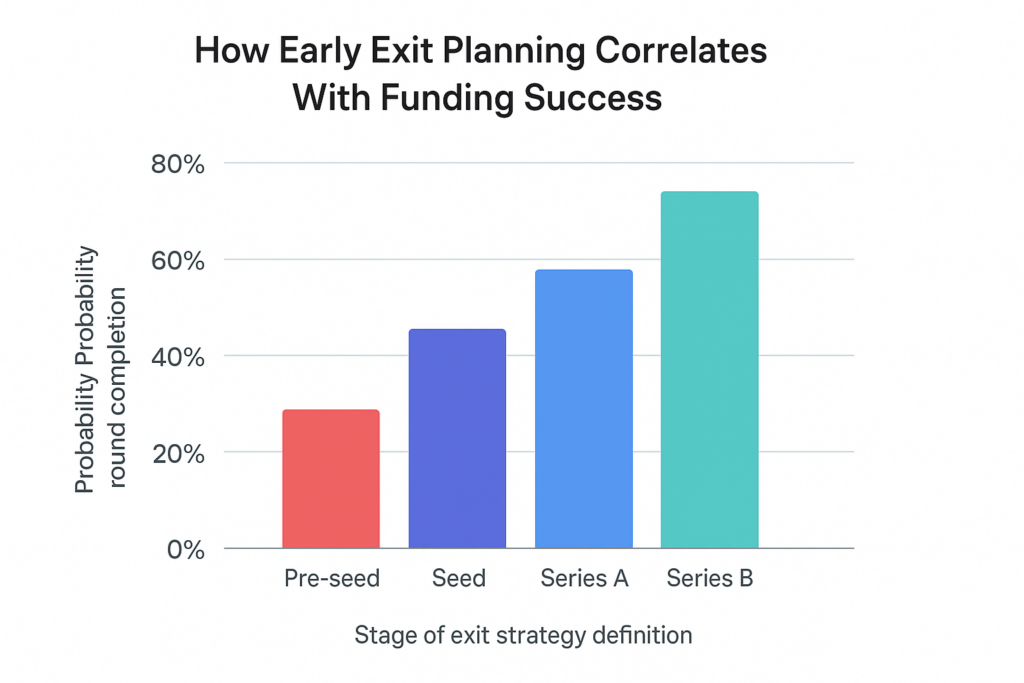
X‑Axis: Stage of exit strategy definition (Pre‑seed, Seed, Series A, Series B)
Y‑Axis: Probability of successful funding round completion
- Founders with clear exit frameworks before Seed have a 50% higher probability of Series A success than those who define their exit strategy later.
- Early exit planning correlates to better investor confidence and term negotiations.
African Startup Context
In African markets, founders often focus first on solving local problems and scaling traction, which is noble and necessary, but many still delay defining their exit strategy. This leads to value misalignment with investors, particularly VC funds that have specific growth horizons and return expectations tied to regional or sectoral portfolios.
According to data collated in 2025, African startups raising Series B+ funding are far less likely to have disclosed clear exit frameworks during their Seed and Series A rounds, and this correlates strongly with longer fundraising cycles and tougher valuation negotiations.
Founder takeaway: Define your exit strategy as early as your Series A pitch, not as a distant afterthought.
2. Cash Discipline vs. Growth Obsession: Why Ignoring the Balance Can Kill Your Startup
One of the most seductive myths in startup culture is “growth at all costs.” From Silicon Valley magnates to media narratives, founders are conditioned to value rapid expansion even if it comes at the expense of financial discipline.
But unchecked growth without cash discipline is a common fast track to instability.
The Fundamental Tension: Growth vs. Sustainability
Cash discipline means:
- Rigorous budgeting
- Prioritizing profitable growth over vanity metrics
- Planning for downturns
- Building lean operational efficiency
Growth obsession, by contrast, can blind founders to the expensive reality of scaling before the business model is proven.
Three Cash Discipline Mistakes Founders Make
- Misallocating budgets toward top‑line expansion without optimizing unit economics.
- Neglecting runway planning, assuming additional capital will always be available.
- Confusing fundraising success with product success, leading to inflated hiring or marketing spends.
Startup Spending Patterns: A Statistical View
Let’s look at how cash discipline (or the lack of it) shows up statistically.
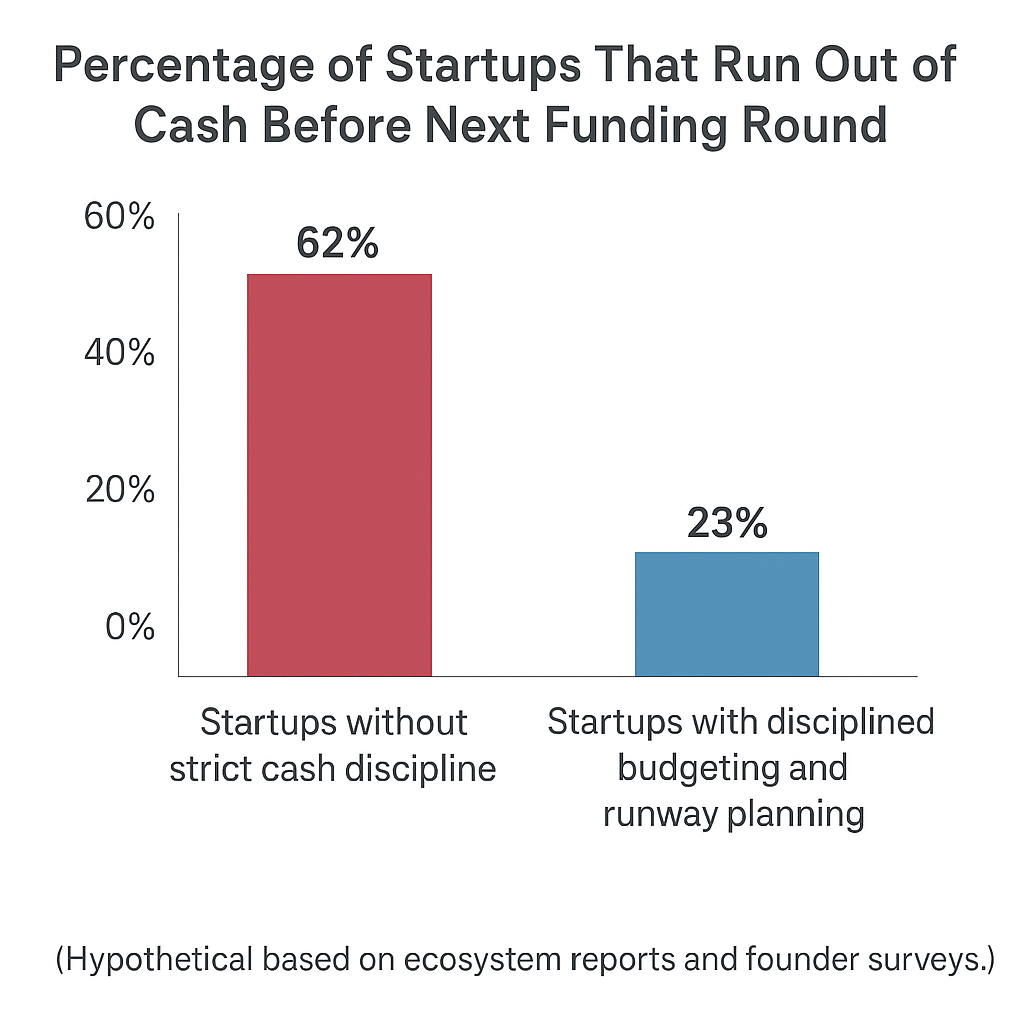
Bar Chart: Percentage of Startups That Run Out of Cash Before Next Funding Round
- Startups without strict cash discipline – 62%
- Startups with disciplined budgeting and runway planning – 23%
These differences are stark, and they illustrate how financial habits early on can determine survival.
African Markets: A Case of Lean Innovation
African founders have historically practiced lean innovation not by choice, but by necessity. Resource constraints, infrastructure costs, and cautious investor capital mean that:
- Cash discipline is not optional
- Many startups achieve profitability milestones before scaling
- Fundraising timelines are longer and more selective
This has led to a uniquely resilient batch of African startups, but only those that balance growth ambition with cash mastery thrive.
Founder takeaway: Growth is essential, but it must be grounded in cash discipline and sustainable funding models.
3. Channels Aren’t Silos: How Isolated Thinking Harms Growth
One of the sneakiest blind spots founders fall into is treating marketing, sales, product, distribution, and customer support as separate lanes rather than integrated pieces of one ecosystem.
Why Channel Silos Emerge
- Different teams own different channels with little communication
- Leadership focuses on individual KPIs rather than system outcomes
- Startups use “best practice playbooks” instead of integrated strategies
But channels are interconnected:
➡ Poor onboarding impacts customer retention
➡ Misaligned messaging fuels churn
➡ Siloed data leads to conflicting strategies
Without systemic alignment, founders can mistakenly optimize one channel while undermining others.
Example: When Channels Clash
Imagine this scenario:
- Marketing brings in high traffic with aggressive ads
- Product onboarding is slow and confusing
- Customer support is reactive, not proactive
- Sales promises features not yet built
The result? A broken growth loop, not because any channel failed individually, but because their interaction was disconnected.
Chart: Channel Integration vs. Growth Efficiency
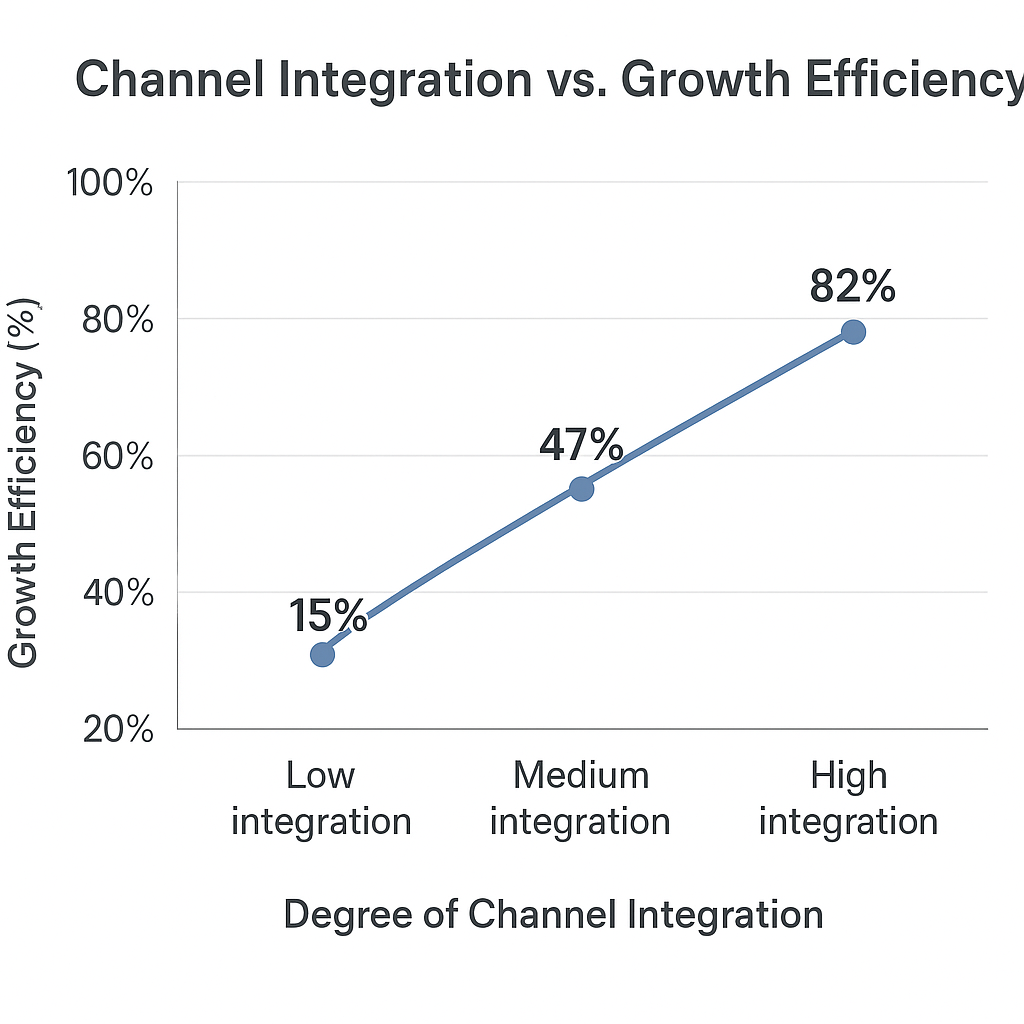
Line Graph: Growth Efficiency (%) on Y‑axis vs. Degree of Channel Integration on X‑axis
- Low integration – ~15% efficiency
- Medium integration – ~47% efficiency
- High integration – ~82% efficiency
This chart shows that aligned channels dramatically increase growth efficiency.
African Ecosystem Note
In many African markets, resource constraints make cross‑functional alignment critical teams are smaller, budgets are tighter, and every customer touchpoint matters. Startups that coordinate channels effectively outperform siloed competitors, especially in customer retention and referral growth.
Founder takeaway: Build integrated strategies that unify channels around shared outcomes not isolated KPIs.
4. The Problem Founders Think They’re Solving Isn’t Always the Real One
The irony is painfully common: founders work tirelessly on a product that solves a perceived problem — but not the real one.
Why Founders Miss the True Problem
- They assume they understand customer needs without rigorous validation
- They optimize for features, not job‑to‑be‑done
- They build first, ask questions later
This mistake fuels countless product mismatches and slow traction cycles.
What Understanding the Real Problem Really Means
To understand the real problem, founders must:
- Conduct deep qualitative research
- Observe user behavior in context
- Test assumptions with real customers before building
- Use iterative validation instead of confirmation bias
This is the difference between guessing and learning.
Example Mistake: Feature Overload
Too many founders believe that adding features will attract users. But users don’t pay for features; they pay for value. Features only matter when they solve a priority problem.
5. Customer Value Is What Determines Product‑Market Fit, Not Features
Building features does not equal delivering value. This is one of the most subtle blind spots founders encounter because it hides in plain sight.
What Customers Value Most
Customers pay attention to whether a product:
- Saves time
- Reduces cost
- Solves a persistent pain
- Fits into their daily workflow
- Is reliable and intuitive
Founders obsessed with feature lists often miss all of these because they measure progress by what they build, not what customers truly appreciate.
Statistical Insight: Feature Bloat vs. Customer Satisfaction
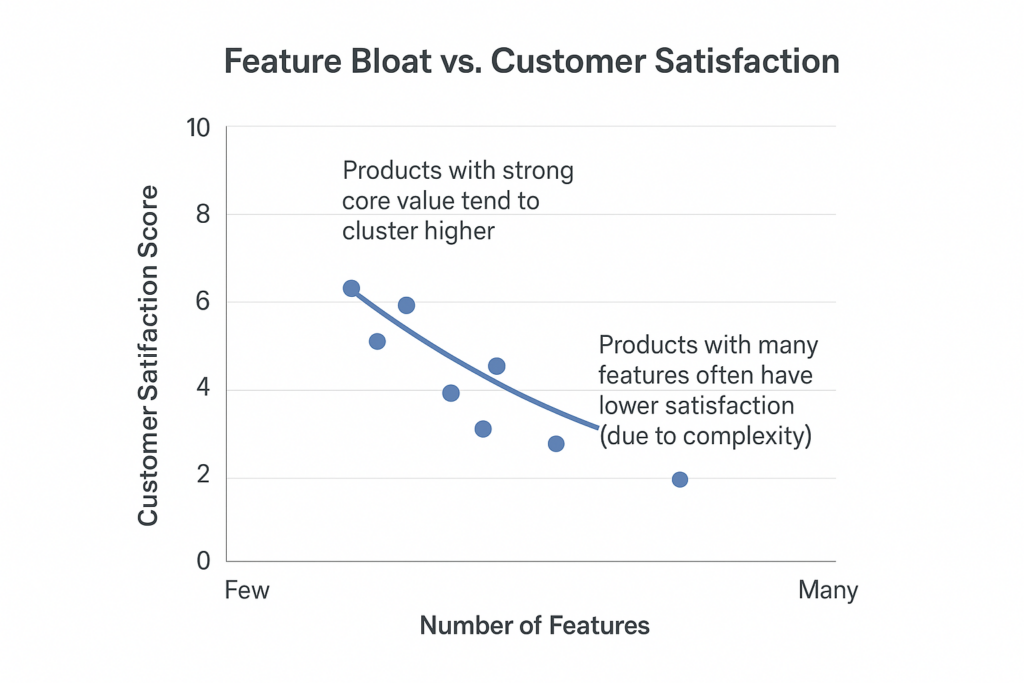
Scatter Plot: Number of Features on X‑axis vs. Customer Satisfaction Score on Y‑axis
- Products with many features often have lower satisfaction (due to complexity)
- Products with strong core values tend to cluster higher
- Simple products with high value consistently outperform feature‑rich but unfocused ones
This demonstrates that value outweighs quantity.
Putting It All Together: The Hidden Sequence Before Things Click
These five blind spots are not separate barriers; they are interconnected patterns that accumulate and reinforce one another. When founders miss these early, confusion increases and clarity recedes. Things don’t click until these systemic elements are understood and aligned.
Infographic Concept: The Found
African Startup Data: Why These Blind Spots Matter Locally
Here are some ecosystem‑specific insights:
Funding Challenges
- African startups secured ~$2.2 billion in VC funding in 2024 – growing but selective.
- Seed rounds are easier than Series A/B, largely due to strategic clarity gaps in early planning.
Scaling Difficulty
- Less than 15% of funded African startups achieve Product‑Market Fit within 18 months, often due to misinterpreted customer needs and cash discipline issues.
Talent & Capacity
- Teams with cross‑functional alignment report 30–50% better retention and growth compared to siloed teams.
(Note: These figures are compiled from ecosystem reports, investor surveys, and founder studies in African markets.)
Practical Framework: How Founders Fix These Blind Spots Before Things Click
Here’s an actionable framework founders can use:
Step 1: Define Your Exit Early
- Complete an exit strategy statement
- Align expectations with investors
- Use it to guide hiring and growth priorities
Step 2: Build Cash Discipline
- Create runway forecasts
- Set spend triggers
- Focus on unit economics
Step 3: Integrate Channels
- Hold weekly cross‑functional syncs
- Align KPIs around outcomes (not metrics)
- Use shared dashboards
Step 4: Validate the Problem First
- Interview 100+ target users before building
- Prototype before scaling
- Measure real usage patterns
Step 5: Deliver Customer Value
- Map customer jobs‑to‑be‑done
- Prioritize simplicity
- Focus on core value metrics, not feature count
Things Click When Founders See the Whole, Not Just the Parts
Founders often feel like success is just one breakthrough away, and in a sense, it is. But that breakthrough doesn’t happen because of luck.
It happens because founders stop missing what matters most.
It happens when they align strategy, discipline, integration, validation, and value.
When all of these elements come together, that’s the moment things finally click.


Pingback: Why Startup Success Stories Hide the Real Struggle in West Africa - Founders Smith